Design history · 1950s–1990s

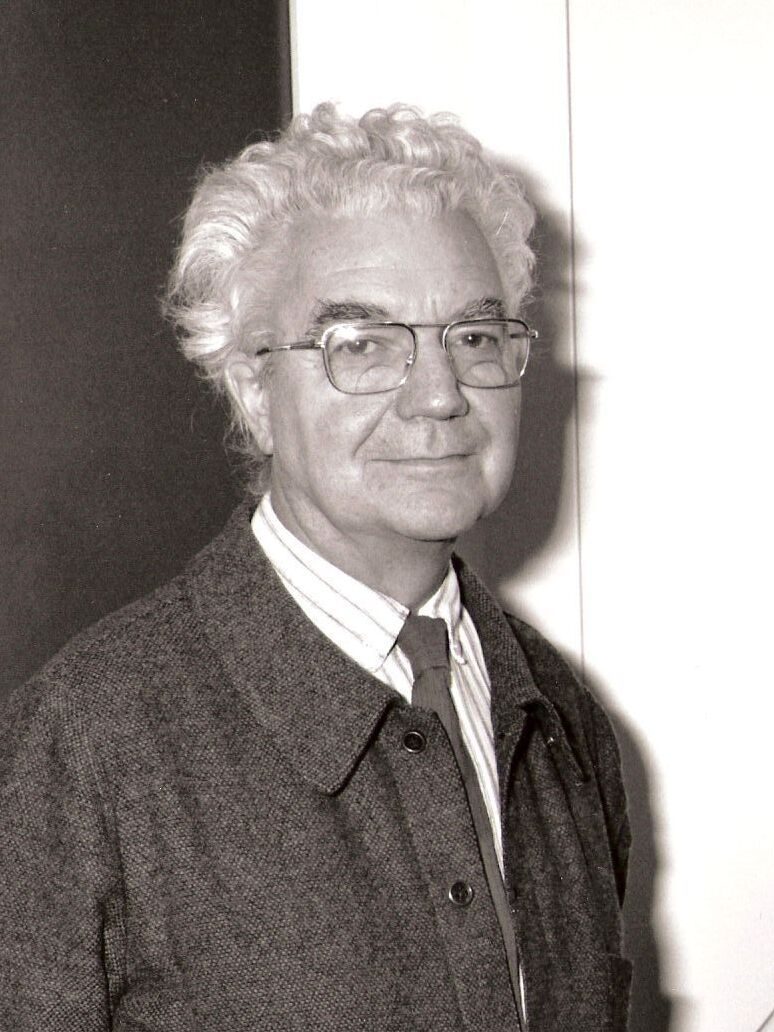
Adrian Frutiger

The Swiss type designer who drew the alphabets we read every day.

Adrian Frutiger (1928–2015) is the Swiss type designer whose typefaces — Univers, Frutiger, Avenir, OCR-B — are among the most widely read letterforms in the world. Charles de Gaulle airport, the London NHS, European road signs, Apple's San Francisco: his work and its descendants are the underlying infrastructure of postwar public typography.

Key facts

Born
24 May 1928, Unterseen, Switzerland
Died
10 September 2015, Bremgarten bei Bern, Switzerland
Nationality
Swiss
Era
Swiss Style · Type design · Wayfinding
Studios
Deberny & Peignot, Paris (art director, 1952–1967) · Atelier Frutiger + Partner, Bern (1962–2008)
Known for
Univers (1957) · Frutiger (1976, Charles de Gaulle airport) · Avenir (1988) · OCR-B (1968)

Biography

Adrian Frutiger was born in Unterseen, near Interlaken, in 1928. He apprenticed as a compositor in Interlaken from 1944 and studied at the Kunstgewerbeschule Zürich from 1949 to 1951. His diploma project, an essay on the evolution of Western letterforms, already contained the question he would spend the next sixty years answering: what makes a Roman capital read as a Roman capital?

In 1952 Charles Peignot recruited him to Deberny & Peignot in Paris. Over fifteen years there he designed President, Meridien, Ondine, Phoebus — and, in 1957, Univers, the typeface that reorganised the type-design field around a numerical matrix. When Deberny & Peignot was absorbed by Haas in 1967, Frutiger continued as an independent designer while keeping a long consulting relationship with Linotype.

The Roissy airport commission in 1968 produced the signage typeface that Linotype released commercially in 1976 as Frutiger. That typeface became the template for humanist wayfinding sans-serifs for the next fifty years — Swiss federal signage, British NHS signage, Oslo airport, countless transport systems.

He continued designing type and writing about letterform theory into his eighties, including Avenir (1988), Vectora (1990) and the revised Frutiger Serif (2008). He died in Bremgarten in 2015, aged 87.

Design philosophy

Frutiger’s position was that legibility is the criterion — not novelty, not expression, not personal style. Type exists to be read, and the designer’s job is to disappear behind the reader’s comprehension.

“The whole essence of my work could be described as the shaping of the counter-space, the shaping of the white. In the end it is always the space that we see — not the letterform.” — Adrian Frutiger

He was famously uninterested in the designer-as-auteur posture. His typefaces are named functionally (Univers, Frutiger, Avenir), his writings are technical rather than polemical, and his interview persona was that of a craftsman describing a workbench. The effect was cumulatively unshowy and disproportionately influential.

His second premise was that a typeface is a system, not a drawing. Univers’s 21-member grid — weights on one axis, widths on the other — treated type families as coordinate spaces. Every subsequent grotesque superfamily (Neue Haas, DIN 2014, San Francisco, Inter) is recognisably downstream of that choice.

Key works

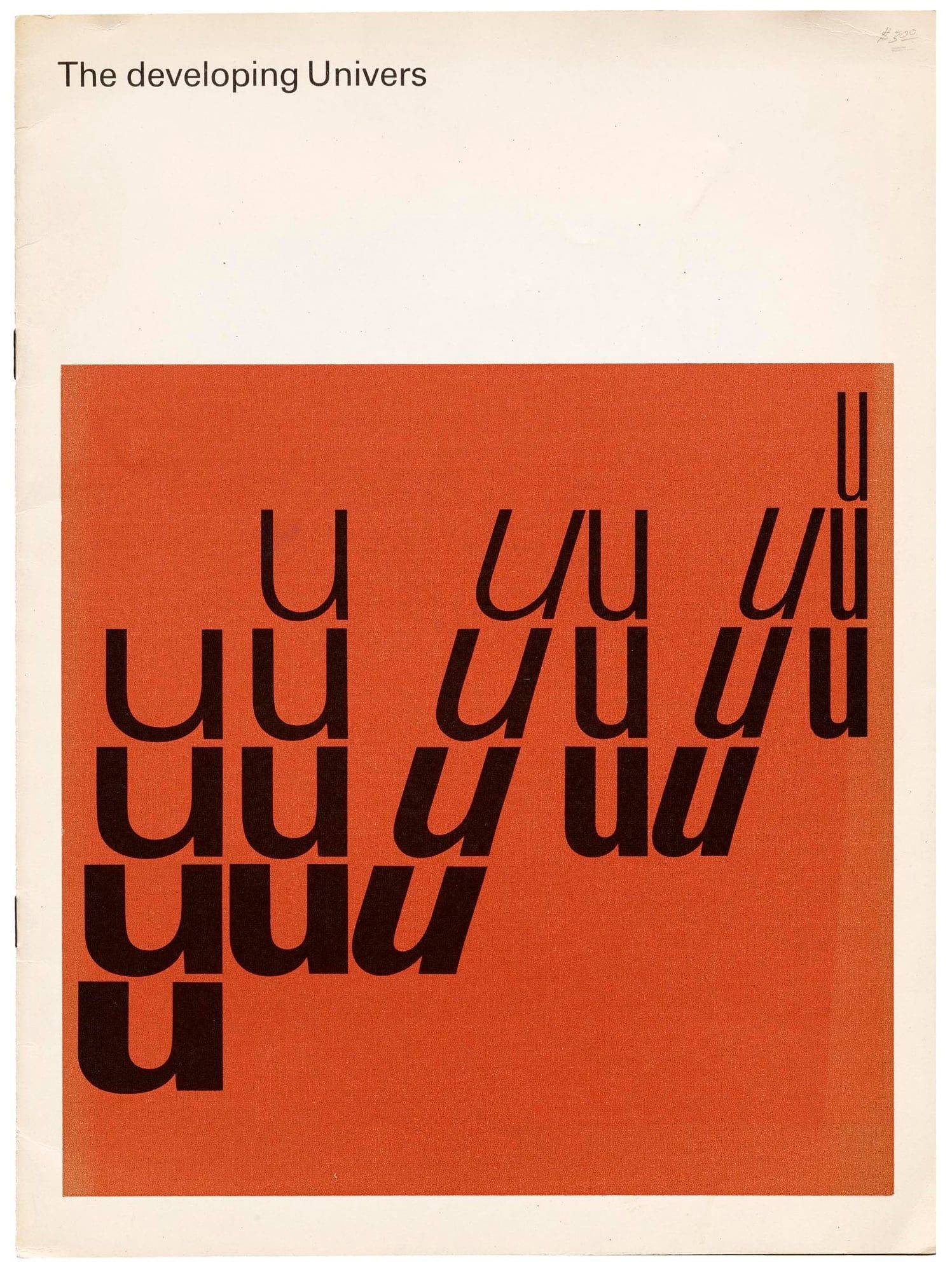
Univers (1957) — 21 weights across a numerical grid. Released by Deberny & Peignot with an explicit marketing argument that the matrix was the typeface. Extended by Linotype Univers (1997) to 59 weights and digitally refined by Adrian Frutiger himself through multiple revisions.

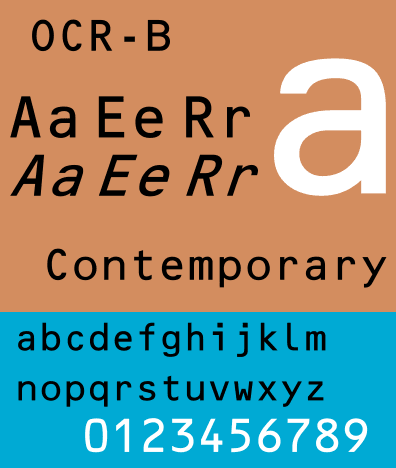
OCR-B (1968) — optical-character-recognition typeface commissioned by the European Computer Manufacturers Association, adopted as ISO 1073-2 in 1976. Still the typeface on the bottom of your passport.

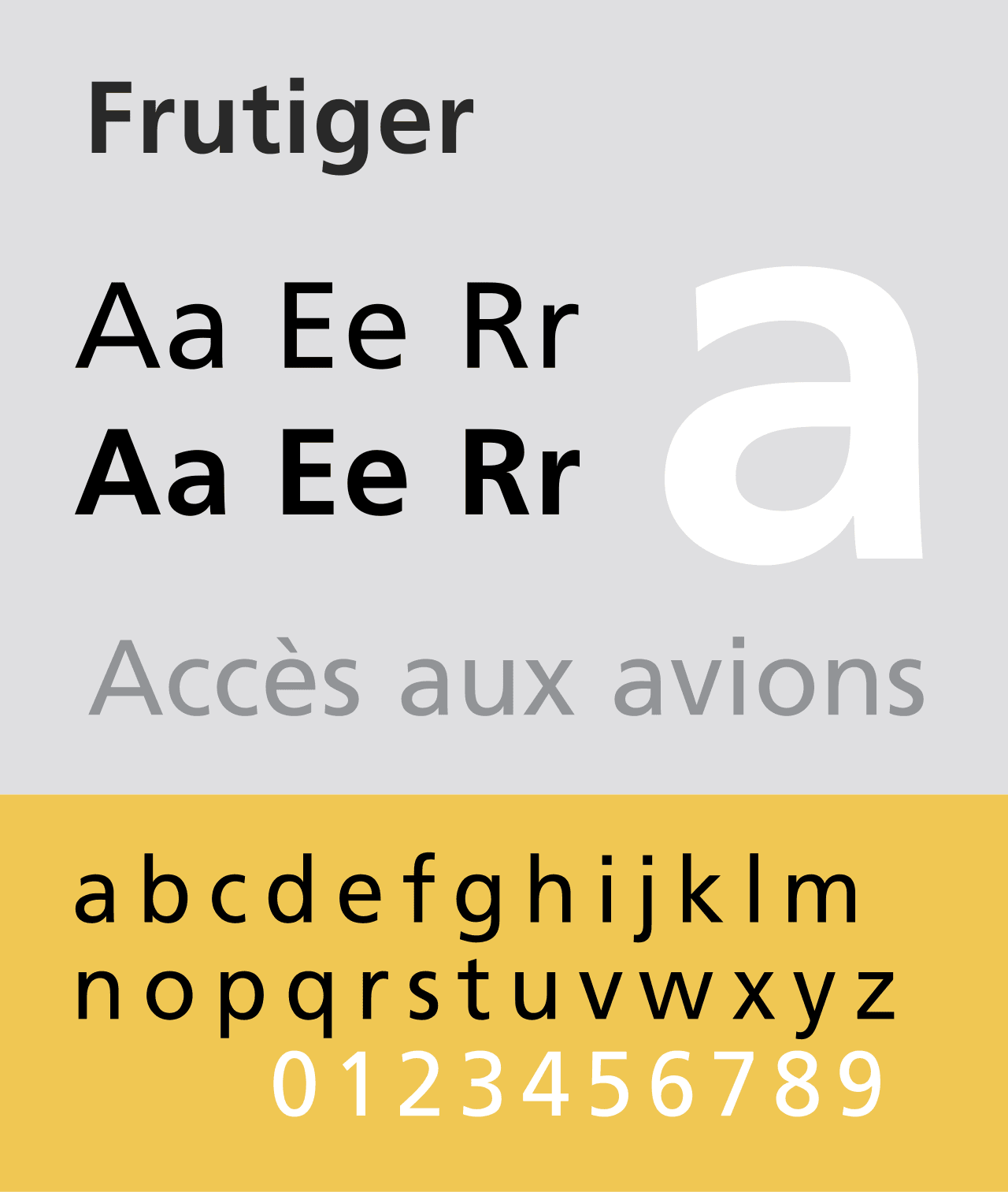
Frutiger (1976) — humanist sans-serif originally designed for the Charles de Gaulle airport signage system. Linotype released it commercially in 1976; by the 2000s it was one of the single most widely licensed signage typefaces in the world.

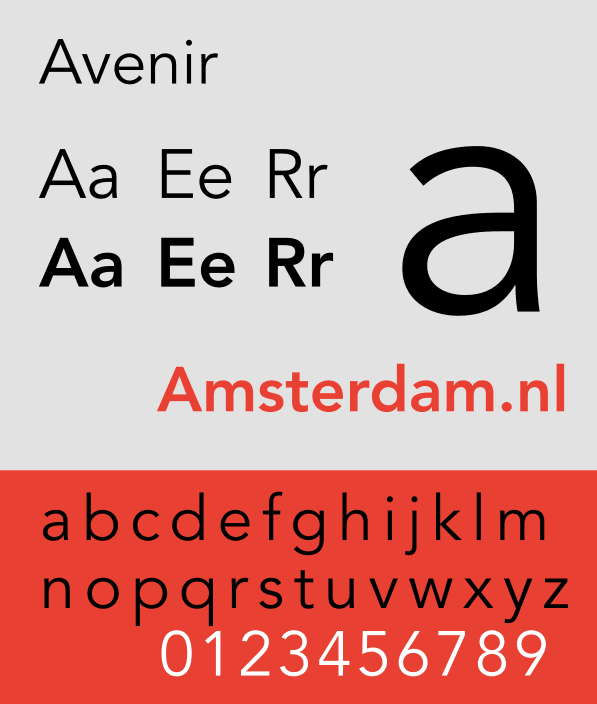
Avenir (1988) — geometric sans-serif; Frutiger’s humanist reworking of Paul Renner’s Futura. Extensively revised with Akira Kobayashi as Avenir Next (2004).

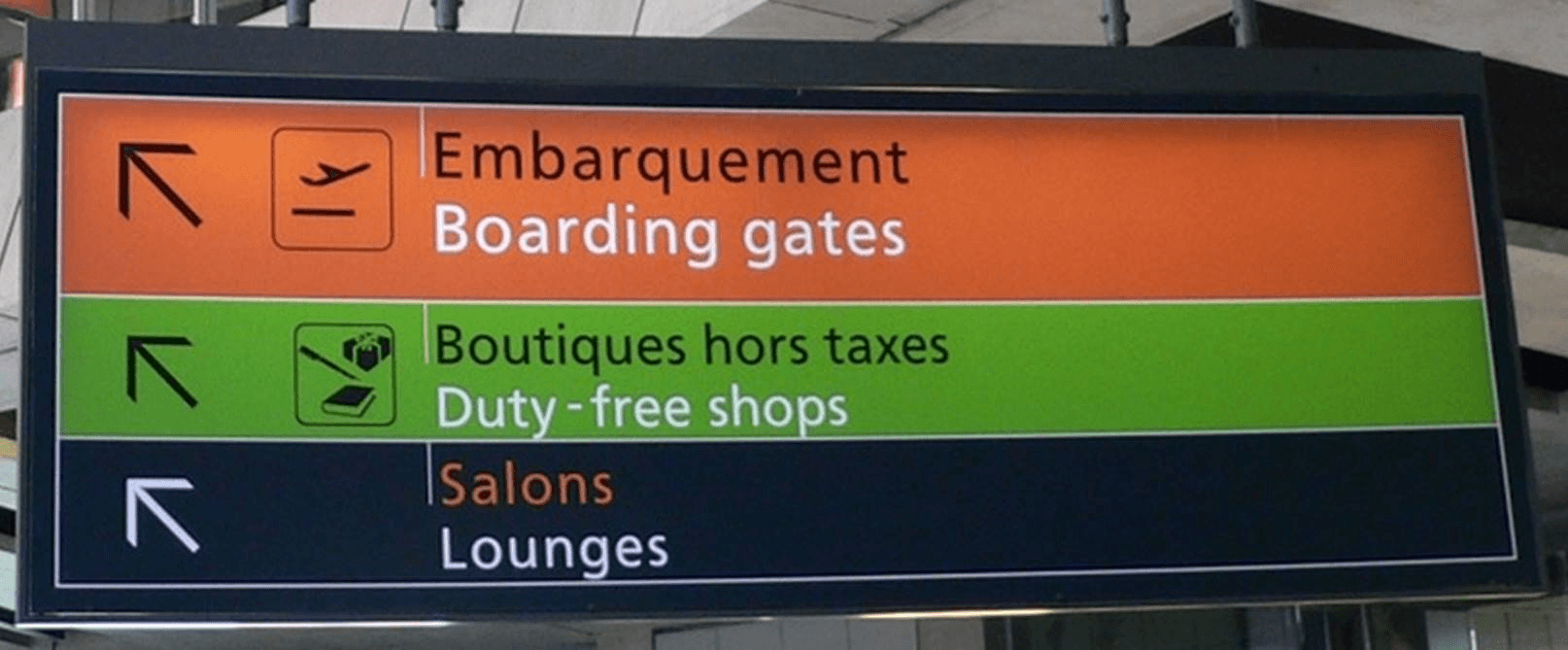
Charles de Gaulle airport wayfinding (1974) — complete signage system for Roissy. The project that produced the Frutiger typeface and became a template for public-space wayfinding.

Méridien (1957) — classical text serif, revised as Méridien Next (2013). Less famous than his sans-serifs but widely used in French book publishing.

Iconic works

Univers, 1957

Univers

1957

Twenty-one-member sans-serif family released by Deberny & Peignot. Introduced Frutiger's numerical weight + width grid (55 Roman, 65 Bold, 66 Bold Italic …) — the first system to treat a typeface as a matrix rather than a list.
Univers (1957).
OCR-B, 1968

OCR-B

1968

Optical-character-recognition typeface commissioned by the European Computer Manufacturers Association. Adopted as ISO 1073-2 in 1976 and still used on passports, cheques and identity documents worldwide.
OCR-B (1968).
Frutiger (typeface), 1976

Frutiger (typeface)

1976

Humanist sans-serif designed for the wayfinding system at Charles de Gaulle airport, Paris. Released commercially by Linotype in 1976; the basis for signage typefaces at London's NHS, Swiss federal signage, and countless airport systems.
Frutiger (typeface) (1976).
Avenir, 1988

Avenir

1988

Geometric sans-serif released by Linotype; Frutiger's humanist reworking of Futura. Extensively revised as Avenir Next with Akira Kobayashi (2004).
Avenir (1988).
Vectora, 1990

Vectora

1990

Text-grade sans-serif designed to bridge humanist warmth and grotesque neutrality; released by Linotype.
Vectora (1990).
Charles de Gaulle airport signage system, 1974

Charles de Gaulle airport signage system

1974

Complete wayfinding system for Roissy airport (now CDG). The typeface originally called "Roissy" was released commercially as Frutiger in 1976.
Charles de Gaulle airport signage system (1974).
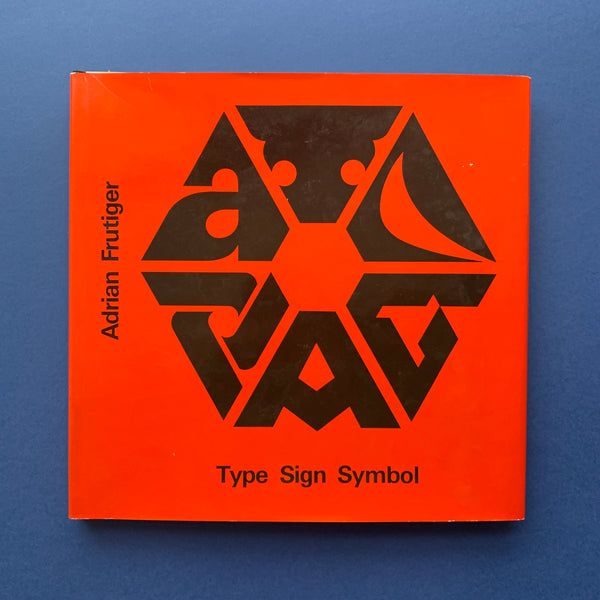
Type Sign Symbol, 1980

Type Sign Symbol

1980

Essay collection on letterform, signage and symbol design. ABC Verlag.
Type Sign Symbol (1980).
Der Mensch und seine Zeichen / Signs and Symbols, 1978

Der Mensch und seine Zeichen / Signs and Symbols

1978

Three-volume theoretical work on the history and geometry of graphic signs. Studio Editions reissue, 1989.
Der Mensch und seine Zeichen / Signs and Symbols (1978).

Influence & legacy

Frutiger’s influence runs through two channels: the typefaces themselves and the grid system behind them. Open any contemporary type specimen and the weight-and-width matrix is there, usually without a credit. Every sans-serif superfamily designed since 1960 — Neue Helvetica, DIN 2014, San Francisco, Inter, Neue Montreal — inherits Univers’s organising logic.

The Frutiger typeface itself is close to ubiquitous in European public signage. The NHS, Swiss federal government, Royal Mail, the Paris Métro, Oslo airport and many others use either Frutiger directly or signage typefaces drawn in conscious descent from it (Wayfinding Sans, Transport, FF Info).

His writings — Type Sign Symbol (1980) and Signs and Symbols (1978) — shaped generations of typography teaching in German- and French-speaking Europe. Robin Kinross’s English-language Modern Typography (1992) treats Frutiger as one of the two pivotal figures of postwar type design, alongside Hermann Zapf.

Learn at TGDS

Frutiger’s work underlies how we teach typography and wayfinding. If his approach interests you, the most direct next steps are:

Courses

Further reading

Books

  • Adrian Frutiger, Type Sign Symbol (ABC Verlag, 1980).
  • Adrian Frutiger, Der Mensch und seine Zeichen / Signs and Symbols (Studio Editions, 1989; originally three volumes, 1978–1981).
  • Heidrun Osterer & Philipp Stamm, Adrian Frutiger – Typefaces: The Complete Works (Birkhäuser, 2008).
  • Robin Kinross, Modern Typography (Hyphen Press, 1992 / 2nd ed. 2004).

Get Started.

You can enrol any day of the year. We are online and study is self-paced, there is no pressure. Enrol when you are ready to start, from anywhere in the world. If you would like to chat or email, feel free to get in touch.

Brochures, Phone Calls & Questions

You can download a free brochure, book a phone call with one of our course advisors, or simply ask a question.

Other ways to get in touch

Australia 1300 655 485

International +61 1300 655 485

Ask Anything info@thegraphicdesignschool.com

Get a quote accounts@thegraphicdesignschool.com

Acknowledgement of Country
The Graphic Design School acknowledges the Traditional Custodians of Country throughout Australia and their continued spiritual connection to land.
We pay respect to Elders past, present and emerging.
Always was, always will be.
RTO Provider № 91706