Design history · 1950s–1980s

Armin Hofmann

The Swiss teacher who reduced graphic form to its minimum — and built the pedagogy that exported Basel worldwide.

Armin Hofmann (1920–2020) is the Swiss graphic designer who turned the Basel School of Design into one of the most influential teaching programmes of the twentieth century. His black-and-white posters for the Basler Freilichtspiele and Stadttheater Basel demonstrate a reductive, form-first visual language, and his 1965 textbook Graphic Design Manual remains in continuous use in design schools worldwide.

Key facts

Born
29 June 1920, Winterthur, Switzerland
Died
18 December 2020, Luzern, Switzerland (aged 100)
Nationality
Swiss
Era
Swiss Style · Basel School · Reductive poster design
Studios
Allgemeine Gewerbeschule Basel (faculty 1947–1987) · Yale University School of Art (visiting faculty 1955–1991)
Known for
Basler Freilichtspiele posters (1954–1990) · Graphic Design Manual (1965) · Co-founding the Basel School of Design

Biography

Armin Hofmann was born in Winterthur in 1920 and trained at the Kunstgewerbeschule Zürich under the emerging Swiss-school generation. He moved to Basel in 1947 to join the Allgemeine Gewerbeschule, where he would teach for forty years — at the invitation of Emil Ruder, who ran the typography department there. The two of them, working in parallel, built what became known internationally as the Basel School of Design.

In 1955 Bradbury Thompson invited him to teach as a visiting instructor at Yale’s graphic design programme. That relationship lasted more than three decades and made Basel’s reductive pedagogy a direct influence on the American design academy. Paul Rand was a colleague at Yale; several generations of American designers — April Greiman, Dan Friedman, Willi Kunz, Hans-Ulrich Allemann — passed through Hofmann’s Basel summer programme and carried its methods home.

His studio output was smaller than his teaching output: a long series of posters for the Stadttheater Basel and the Basler Freilichtspiele, a sustained relationship with the Swiss Mustermesse trade fair, and Herman Miller commissions through George Nelson’s New York office. He retired from full-time teaching in 1987, continued with the Yale summer programme until the early 1990s, and died in Luzern in 2020 at the age of one hundred.

Design philosophy

Hofmann’s teaching was built around form and counterform — the idea that the shape of what is present and the shape of what is absent are the same problem, seen from two directions. A letterform, a photograph, a colour field: each is defined as much by the space it isn’t as by the space it is.

“The graphic designer must be able to distinguish form from its surroundings, to recognise the effects of reductive working methods, to understand how contrasts and tensions can be created out of a limited vocabulary of elements.” — Armin Hofmann, Graphic Design Manual (1965)

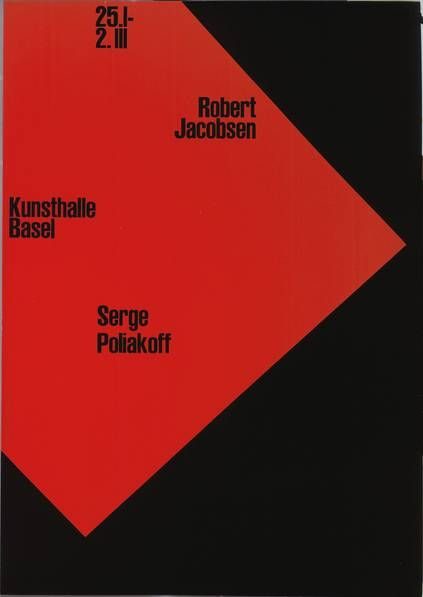
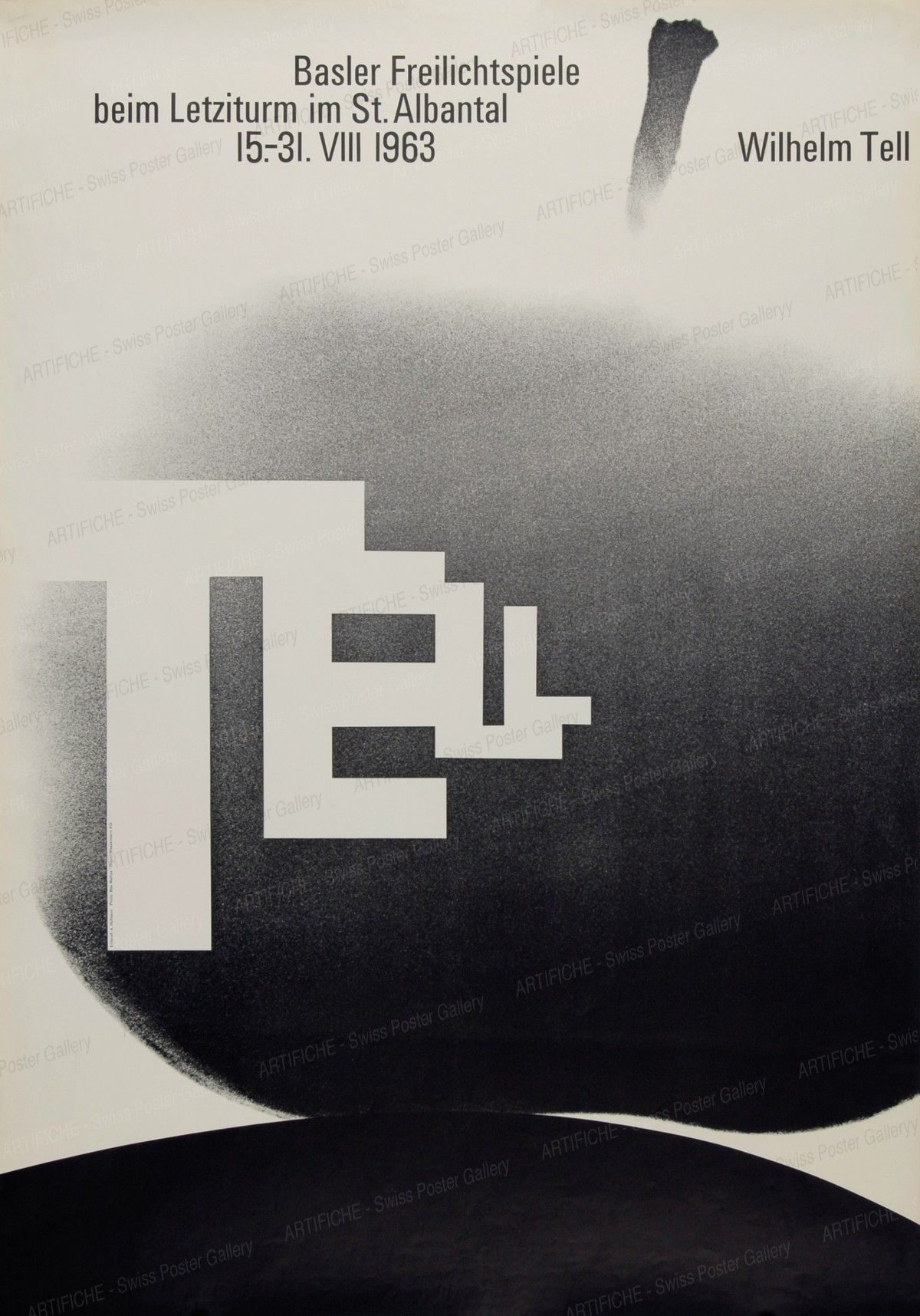
His second premise was that reduction is a discipline, not a style. The Basler Freilichtspiele posters typically use one or two elements, often black-and-white, often a single photograph cropped hard against typography. The argument is pedagogical: the student who can make one element do the work of five has understood something that the student layering seven elements has not.

His third premise was that graphic design is built from a small vocabulary: point, line, plane, letter, photograph, contrast. Teach those elements deeply and the work writes itself.

Key works

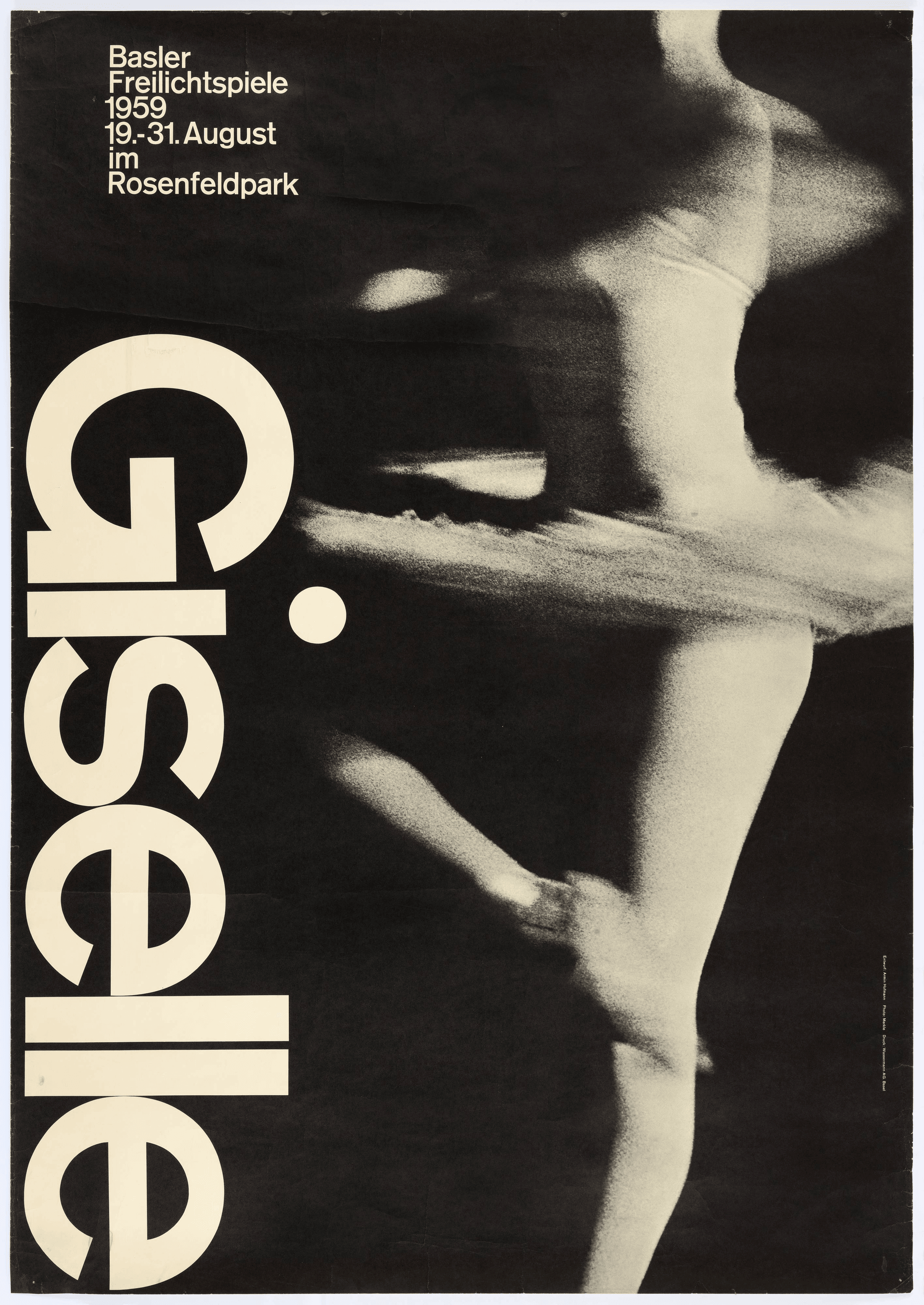
Basler Freilichtspiele posters (1954–1990) — the open-air-theatre festival in Basel. More than three decades of posters, almost all monochromatic, typographically reduced. The 1959 Giselle poster (a single dancer’s silhouette against black with white typography) is the most reproduced teaching example.

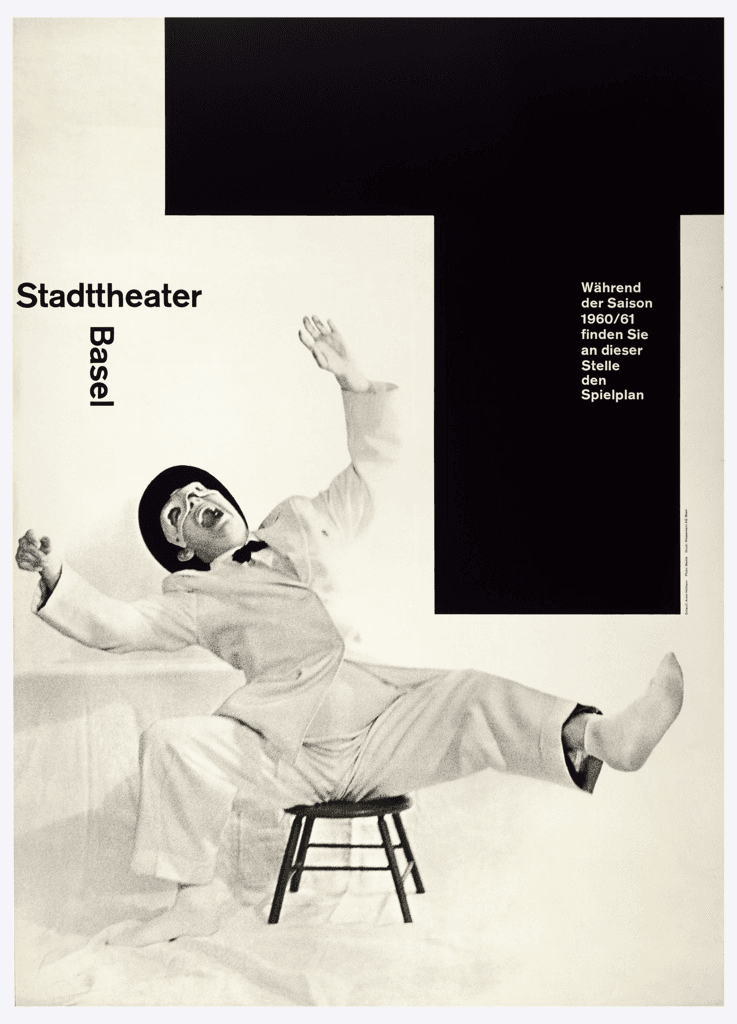
Stadttheater Basel posters (1955–1975) — the municipal theatre. The body of work where Hofmann’s photographic cropping reached its peak; often a single element at extreme scale locked against small typography.

Swiss Mustermesse posters (1960s) — trade-fair graphics for Basel’s annual industrial fair. A different register — more colour, more structural interplay — but the same reductive method applied to a commercial brief.

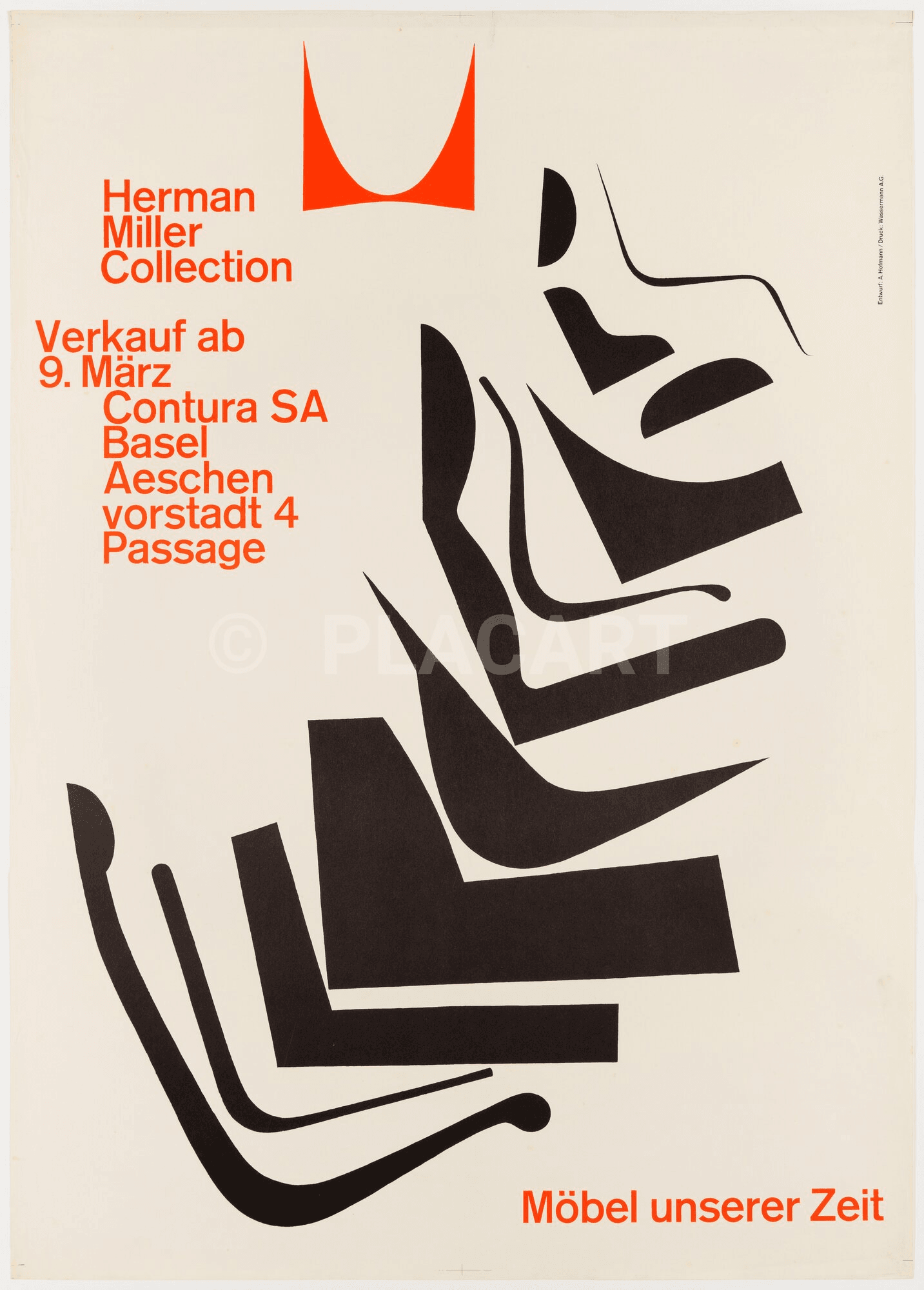
Herman Miller posters (1961–1989) — commissioned through George Nelson’s office. A sustained American client that let the Basel method circulate in corporate communication on the other side of the Atlantic.

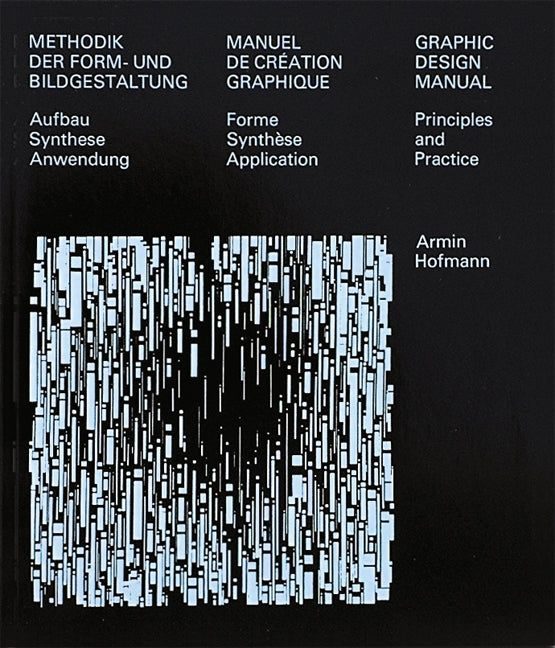
Graphic Design Manual (1965) — the textbook. Not a monograph on Hofmann’s own work; a pedagogical statement about how to teach graphic design from first principles. Niggli keeps it permanently in print.

Iconic works

Basler Freilichtspiele poster series, 1954/1990

Basler Freilichtspiele poster series

1954/1990

Posters for Basel's open-air theatre festival, produced from 1954 to 1990, almost all monochromatic and typographically reduced, printed by Wassermann A.G., Basel. The Giselle poster (1959, photography by Merkle) is held by MoMA as a gift of the artist, by SFMOMA, and by the Cooper Hewitt, Smithsonian Design Museum; it is the most frequently reproduced teaching example from the series. The 1963 Wilhelm Tell poster received the Swiss Poster Award that year.
Basler Freilichtspiele poster series (1954/1990).
Stadttheater Basel poster series, 1955/1975

Stadttheater Basel poster series

1955/1975

Performing-arts posters for Basel's municipal theatre, produced from 1955 to 1975. Hofmann applied extreme photographic cropping at large scale against tight, reduced typography. SFMOMA holds examples from 1958 and 1968, both acquired in 2014; the series represents the period when Hofmann's integration of photography and letterform reached its most concentrated form.
Stadttheater Basel poster series (1955/1975).
Herman Miller poster series, 1961/1989

Herman Miller poster series

1961/1989

Posters produced for Herman Miller's European presence, beginning with a 1962 commission by Contura, Herman Miller's Basel-based Swiss distributor, for an exhibition of the company's furniture. The 1962 lithograph (Möbel unserer Zeit), printed by Wassermann A.G., Basel, is held by MoMA as a gift of the artist. The series brought the Basel reductive vocabulary into contact with American corporate communication over nearly three decades.
Herman Miller poster series (1961/1989).
Graphic Design Manual / Methodik der Form- und Bildgestaltung, 1965

Graphic Design Manual / Methodik der Form- und Bildgestaltung

1965

Hofmann's primary theoretical statement, published by Niggli Verlag, Basel, under the parallel titles Graphic Design Manual: Principles and Practice (English) and Methodik der Form- und Bildgestaltung: Aufbau, Synthese, Anwendung (German). The trilingual edition (German, English, French) has remained continuously in print since 1965. Where Müller-Brockmann's Grid Systems addresses layout structure and Ruder's Typographie addresses letterform, Hofmann's Manual addresses the underlying logic of visual form: point, line, plane, contrast, and their interactions.
Graphic Design Manual / Methodik der Form- und Bildgestaltung (1965).

Influence & legacy

Hofmann’s influence runs through the Basel School of Design and its American export. Every designer who passed through the Basel or Yale graduate programmes between 1955 and 1990 absorbed some version of his form-and-counterform pedagogy — April Greiman, Dan Friedman, Willi Kunz, Hans-Ulrich Allemann, Steff Geissbühler, Dorothea Hofmann (his wife and long-time teaching partner). Through them the method entered American design education directly.

His Graphic Design Manual sits alongside Müller-Brockmann’s Grid Systems and Ruder’s Typographie as the three canonical Swiss-school textbooks. Where Müller-Brockmann wrote about layout and Ruder about typography, Hofmann wrote about the underlying logic of visual form — what a point is, what a line is, what a plane is, how they combine.

The MoMA, the Zürich Museum für Gestaltung and the Merrill C. Berman collection hold major examples of his posters. He received the AIGA Medal in 1987 and the Swiss Federal Design Award that same year.

Learn at TGDS

Hofmann’s form-first pedagogy is the spine of how we teach composition. If his approach resonates, the most direct next steps are:

Courses

Further reading

Books

  • Armin Hofmann, Graphic Design Manual: Principles and Practice / Methodik der Form- und Bildgestaltung (Niggli, 1965).
  • Armin Hofmann, Armin Hofmann: His Work, Quest and Philosophy (Birkhäuser, 1989).
  • Dorothea Hofmann & Armin Hofmann, Reduction · Ethics · Didactics (Lars Müller Publishers, 2003).
  • Steven Heller & Elinor Pettit, Graphic Design Time Line: A Century of Design Milestones (Allworth Press, 2000) — Basel School coverage.

Get Started.

You can enrol any day of the year. We are online and study is self-paced, there is no pressure. Enrol when you are ready to start, from anywhere in the world. If you would like to chat or email, feel free to get in touch.

Brochures, Phone Calls & Questions

You can download a free brochure, book a phone call with one of our course advisors, or simply ask a question.

Other ways to get in touch

Australia 1300 655 485

International +61 1300 655 485

Ask Anything info@thegraphicdesignschool.com

Get a quote accounts@thegraphicdesignschool.com

Acknowledgement of Country
The Graphic Design School acknowledges the Traditional Custodians of Country throughout Australia and their continued spiritual connection to land.
We pay respect to Elders past, present and emerging.
Always was, always will be.
RTO Provider № 91706