Design history · 1940s–1960s

Josef Müller-Brockmann

The Swiss designer who proved the grid is a tool for clarity, not constraint.

Josef Müller-Brockmann (1914–1996) is the Swiss graphic designer who codified the International Typographic Style. His Tonhalle Zürich concert posters turned the grid and Akzidenz-Grotesk into an expressive instrument, and his 1981 textbook Grid Systems in Graphic Design remains the single most widely taught book on layout anywhere in the world.

Key facts

Born
9 May 1914, Rapperswil, Switzerland
Died
30 August 1996, Unterengstringen, Switzerland
Nationality
Swiss
Era
Swiss Style · International Typographic Style · Objective design
Studios
Müller-Brockmann & Co., Zürich (founded 1951) · IBM Europe (design consultant, 1966–1988)
Known for
Tonhalle Zürich concert posters (1951–1972) · Grid Systems in Graphic Design (1981) · Neue Grafik journal (co-founder, 1958)

Biography

Josef Müller-Brockmann was born in Rapperswil on Lake Zürich in 1914 and trained first as a design and typography apprentice before enrolling at the Kunstgewerbeschule and University of Zürich. His early career ran through illustration, exhibition design and stage design — not yet the systematic graphic work he became famous for.

The turning point was personal. His wife, the violinist Verena Brockmann, died in a car accident in 1958. Müller-Brockmann — by then already running his own studio — withdrew almost entirely from illustration and committed to a reduced, objective visual language. In 1951 he had begun designing posters for the Tonhalle-Gesellschaft Zürich; over the next two decades that series became the public face of the International Typographic Style.

From 1957 he taught at the Kunstgewerbeschule Zürich. In 1958 he co-founded the journal Neue Grafik / New Graphic Design with Richard Paul Lohse, Hans Neuburg and Carlo Vivarelli — a trilingual quarterly that became the export vehicle for Swiss design thinking. From 1966 until 1988 he served as design consultant to IBM Europe, applying Rand’s American corporate-identity logic to European applications.

His 1981 book Grid Systems in Graphic Design arrived late in his career but became his most widely read work. He remained active in Zürich until his death in 1996.

Design philosophy

Müller-Brockmann’s position was that graphic design is a form of objective visual communication — and that objectivity is achieved through systematic construction, not personal expression.

“The grid system is an aid, not a guarantee. It permits a number of possible uses and each designer can look for a solution appropriate to his personal style. But one must learn how to use the grid; it is an art that requires practice.” — Josef Müller-Brockmann, Grid Systems in Graphic Design (1981)

He saw the grid as a tool for thinking, not a cage. The mathematical proportions of a grid column, the baseline rhythm, the relationship between type size and line-length — all of this, he argued, exists to serve legibility and clarity. When the grid does its job, the designer disappears and the content speaks directly.

His second premise: form is constructed, not decorated. The concert posters have no ornament, almost no colour beyond their systematic palette, and only one typeface family (Akzidenz-Grotesk, then later Helvetica). What they have instead is geometry — circles, arcs, nested rectangles — arranged to make rhythm visible.

Key works

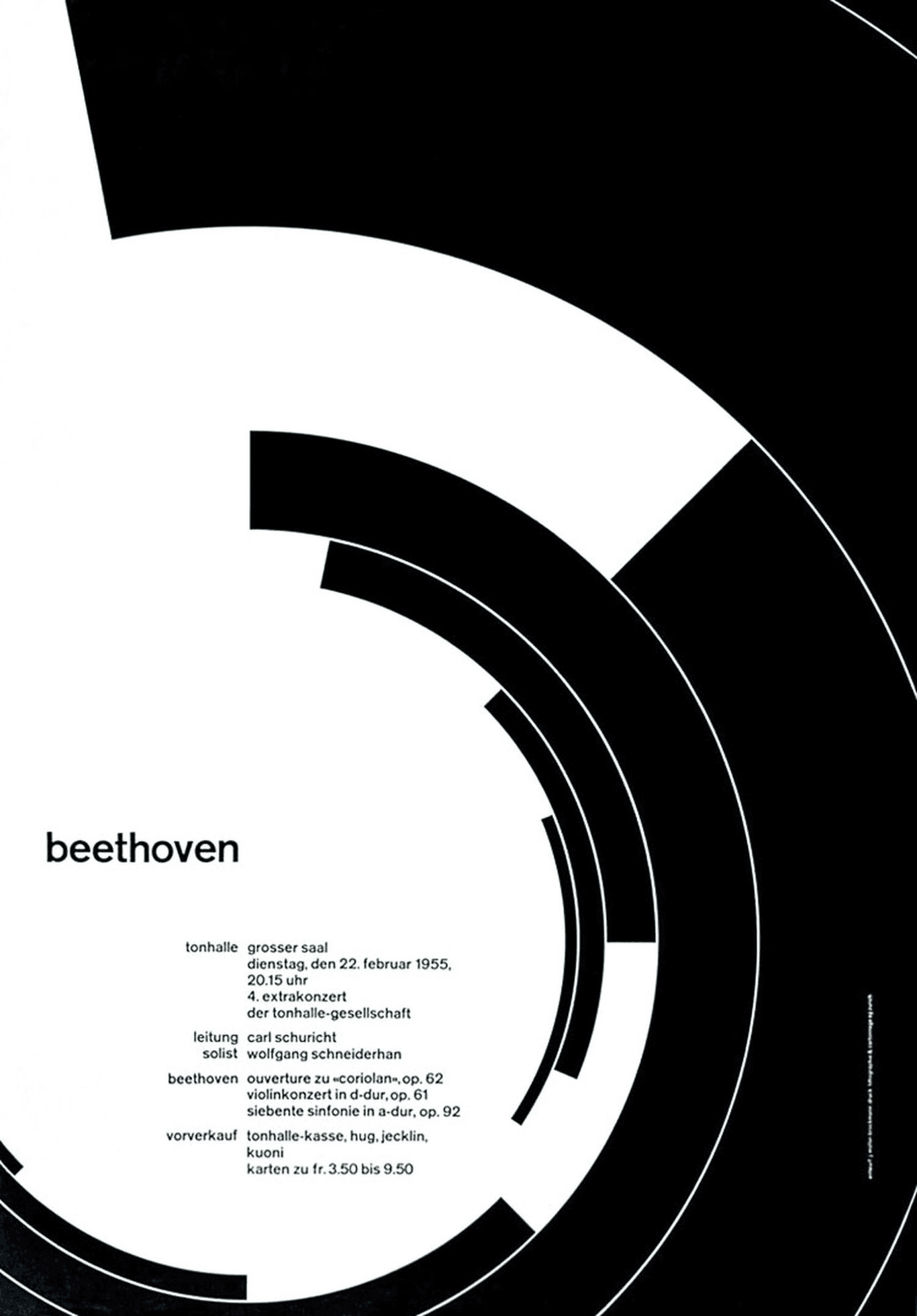
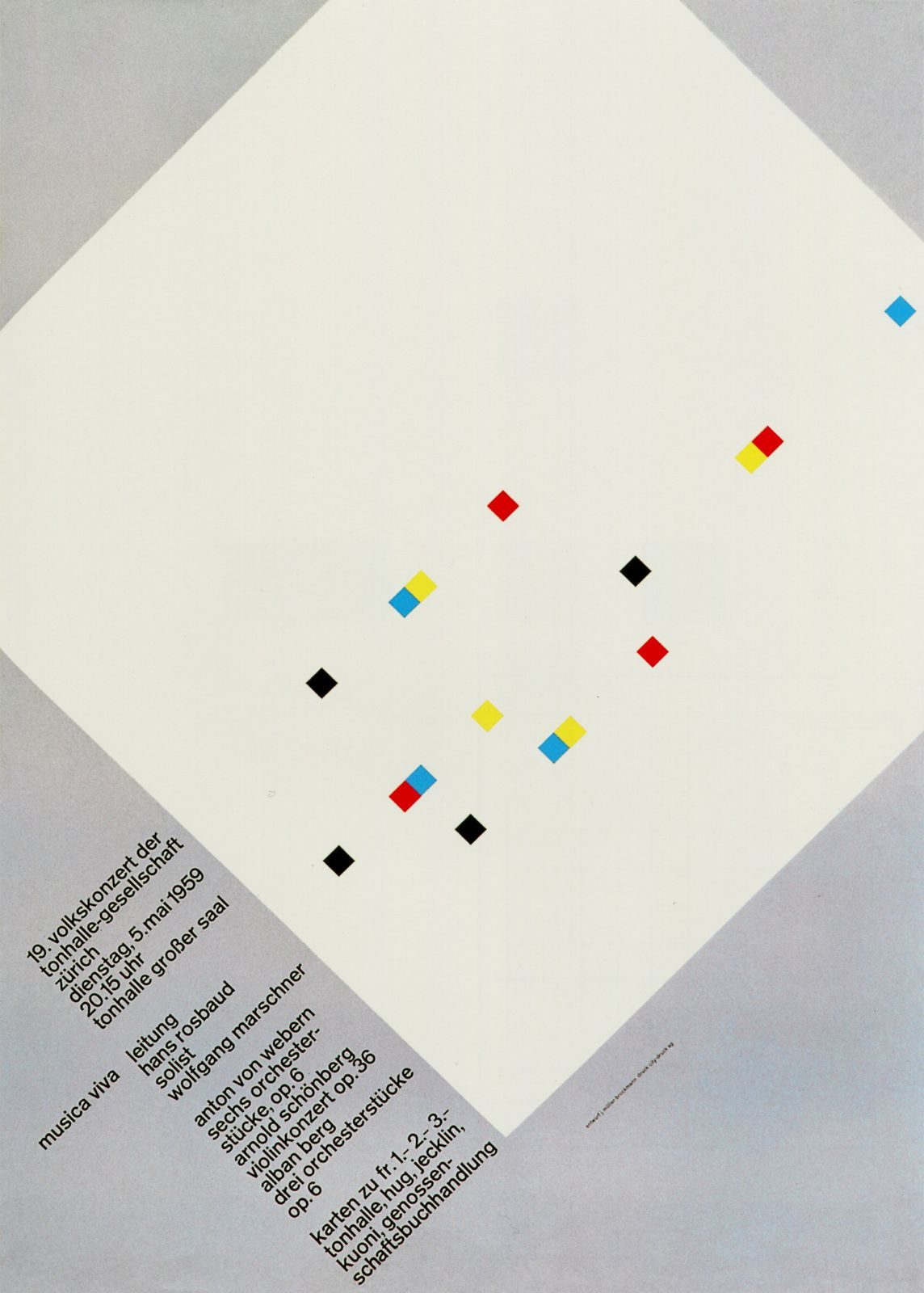
Tonhalle Zürich concert posters (1951–1972) — more than seventy posters produced over two decades for the Tonhalle-Gesellschaft Zürich. The 1955 Musica Viva poster (nested circular forms) and the 1957 Beethoven poster (concentric arcs) are textbook objects in every serious design programme.

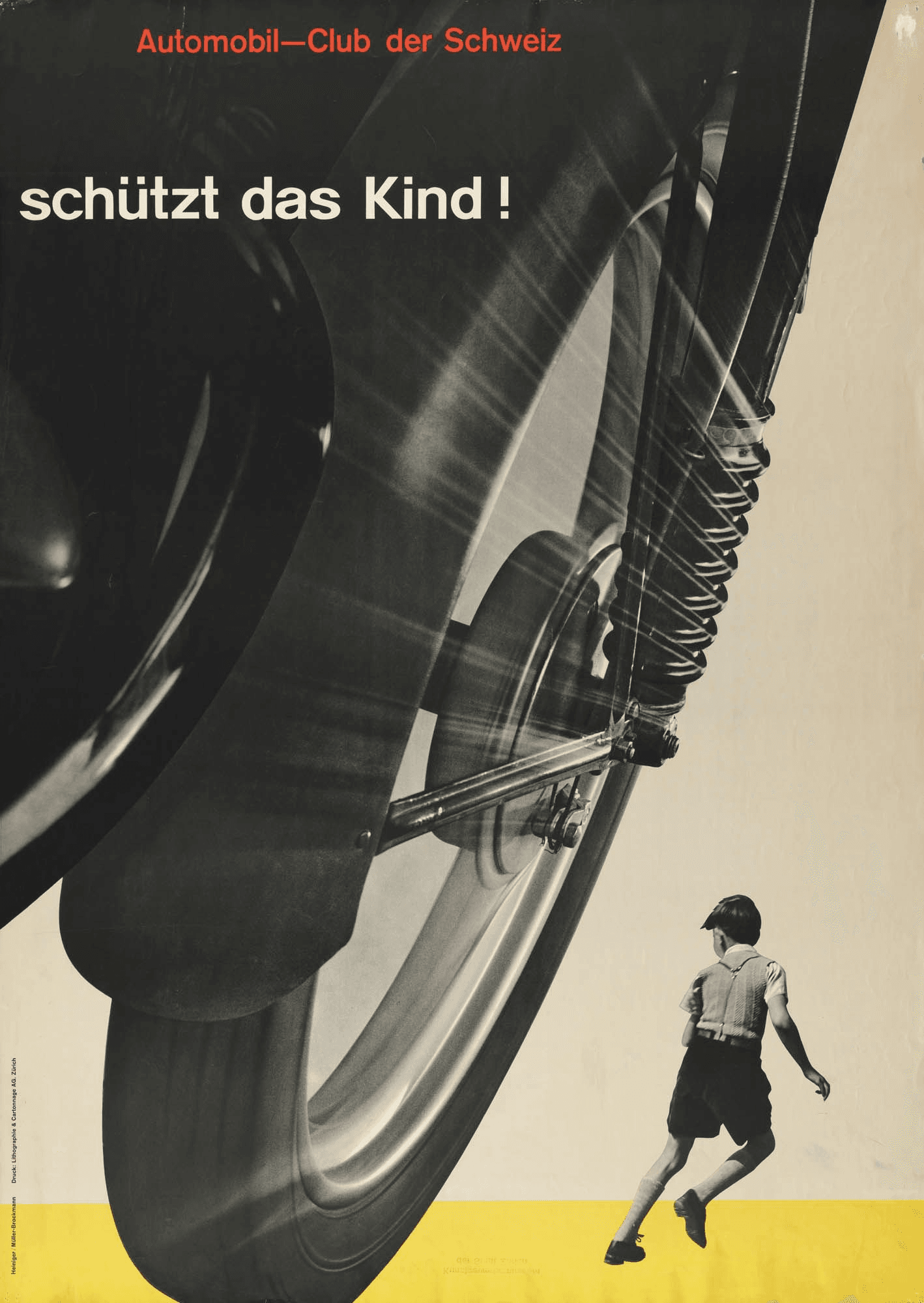
“schützt das kind!” (1953) — Swiss Automobile Club motoring-safety poster. A single black-and-white photomontage of a child crossing a road with a giant motorcycle behind. Exemplary of how Swiss design carried public-information gravitas without pictorial sentimentality.

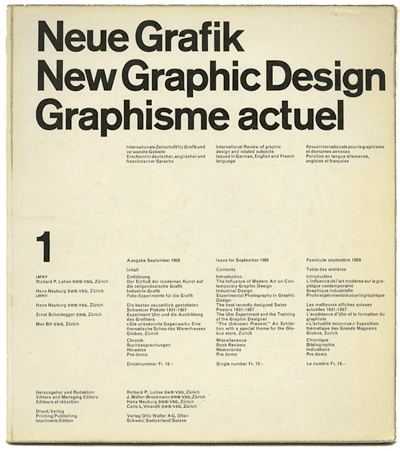
Neue Grafik journal (1958–1965) — co-founded with Lohse, Neuburg and Vivarelli. Eighteen trilingual issues across seven years. The journal itself — its cover grid, its modular text blocks — was the demonstration object for what it advocated.

Grid Systems in Graphic Design (1981) — bilingual textbook that moved the Swiss-school method out of the classroom and into every subsequent generation’s reading list. Niggli keeps it permanently in print.

IBM Europe corporate work (1966–1988) — exhibition graphics, brochures, trade-fair stands. Less canonised than Rand’s American IBM work but applying the same systematic logic across European markets.

Iconic works

Tonhalle Zürich concert poster series, 1951/1972

Tonhalle Zürich concert poster series

1951/1972

A series of seventy-plus posters for the Tonhalle-Gesellschaft Zürich, produced between 1951 and 1972. The 1955 Beethoven and 1961 Musica Viva designs reduced musical composition to geometry (concentric arcs, nested rectangles, systematic type) and became teaching objects in design programmes worldwide. Originals are held at the Kunstgewerbemuseum Zürich and in the collection of MoMA, New York.
Tonhalle Zürich concert poster series (1951/1972). · Josef Müller-Brockmann Überholem..? Im Zweifel nie!(Overtaking? When in doubt, never!) 1957 · Museum editorial
Swiss Automobile Club traffic-safety posters, 1953/1960

Swiss Automobile Club traffic-safety posters

1953/1960

"Schützt das Kind!" (Protect the Child!, 1952/53) used photography by Ernst A. Heiniger alongside spare typography to deliver a road-safety message without sentimentality. The series, commissioned by the Swiss Automobile Club between 1953 and 1960, also included "Weniger Lärm" (Less Noise, 1960). The posters are a standard reference in Swiss-school curricula for the use of photomontage in public information design.
Swiss Automobile Club traffic-safety posters (1953/1960). · Josef Müller-Brockmann Das FreundlicheHandzeichen, Schützt vor Unfällen 1954 · Museum editorial
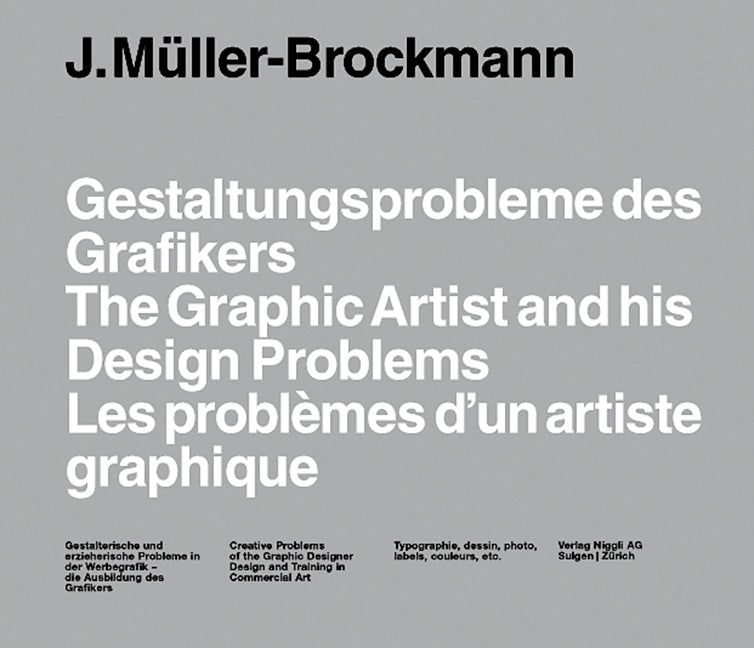
Gestaltungsprobleme des Grafikers / The Graphic Artist and His Design Problems, 1961

Gestaltungsprobleme des Grafikers / The Graphic Artist and His Design Problems

1961

Published by Verlag Arthur Niggli, Teufen, in 1961, in a German/English bilingual edition under the English title The Graphic Artist and His Design Problems. The book laid out the theoretical case for objective, systematic graphic design, covering typography, layout, poster design and exhibition graphics. It preceded Grid Systems in Graphic Design (1981) as the first full written statement of Müller-Brockmann's method.
Gestaltungsprobleme des Grafikers / The Graphic Artist and His Design Problems (1961). · Josef Müller-Brockmann Poster for a concertat Tonhalle Zürich 1953 · Museum editorial
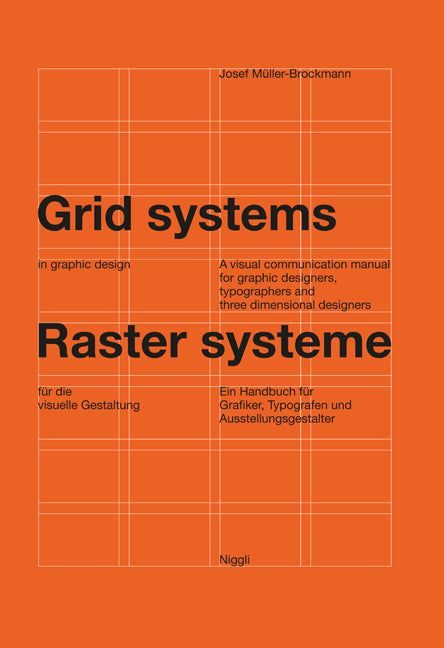
Grid Systems in Graphic Design / Raster Systeme für die visuelle Gestaltung, 1981

Grid Systems in Graphic Design / Raster Systeme für die visuelle Gestaltung

1981

Published in 1981 by Verlag Arthur Niggli, Niederteufen, under the parallel German title Rastersysteme für die visuelle Gestaltung (ISBN 978-3-7212-0145-1). The book sets out, in systematic detail, how to construct and apply column grids, modular grids, and baseline grids to print and multi-page publication design. It has remained in continuous print since first publication and is the most widely assigned grid-systems textbook in design education.
Grid Systems in Graphic Design / Raster Systeme für die visuelle Gestaltung (1981). · Josef Müller-Brockmann Werner Bischof 1957 · Museum editorial
A History of Visual Communication, 1971

A History of Visual Communication

1971

Published by Verlag Arthur Niggli, Teufen, in 1971, in a trilingual edition (German, French, English). The book surveys the history of written and visual communication from prehistoric mark-making through the development of printing and into twentieth-century graphic design practice. It remains one of the few comprehensive one-volume histories of visual communication written by a practising designer.
A History of Visual Communication (1971). · Sarah Morris Creative ArtistsAgency (Los Angeles) 2005 · Museum editorial
Neue Grafik / New Graphic Design (journal), 1958/1965

Neue Grafik / New Graphic Design (journal)

1958/1965

Published under the trilingual title Neue Grafik / New Graphic Design / Graphisme actuel between 1958 and 1965, with eighteen issues in total. Co-founded by Müller-Brockmann with Richard Paul Lohse, Hans Neuburg, and Carlo Vivarelli, and printed by Verlag Otto Walter. The journal's own layout, a strict modular grid set in Akzidenz-Grotesk, served as a live demonstration of the design principles it published. Lars Müller Publishers issued a facsimile reprint of all eighteen issues in 2014.
Neue Grafik / New Graphic Design (journal) (1958/1965). · Josef Müller-Brockmann Poster for a concertat Tonhalle Zürich 1953 · Museum editorial

Influence & legacy

The Swiss-school method Müller-Brockmann codified has never really gone away. It sat at the core of design education through the 1960s and 1970s, was rebelled against in the 1980s postmodern break, and came roaring back with the digital design-systems era of the 2000s. Every modern web layout framework — from the early CSS grid frameworks through Bootstrap and Tailwind — is recognisably downstream of Grid Systems in Graphic Design.

His direct influence flows through IBM, through the designers who trained at Zürich in the 1960s (Pierre Mendell, Ernst Keller students), and through the Neue Grafik readers who exported the method worldwide — from British Penguin reissues to Japanese post-war identity design.

Contemporary designers still cite him constantly. Massimo Vignelli, Paul Rand, Wim Crouwel and Michael Bierut have all named him among their most important influences. The Design Museum London and MoMA hold major examples of his posters.

Learn at TGDS

Müller-Brockmann is the background to how we teach layout. If his work interests you, the most direct next steps are:

Courses

Further reading

Books

  • Josef Müller-Brockmann, Grid Systems in Graphic Design / Raster Systeme für die visuelle Gestaltung (Niggli, 1981).
  • Josef Müller-Brockmann, The Graphic Artist and His Design Problems (Niggli, 1961).
  • Josef Müller-Brockmann, A History of Visual Communication (Niggli, 1971).
  • Kerry William Purcell, Josef Müller-Brockmann (Phaidon Press, 2006) — the definitive monograph in English.
  • Neue Grafik / New Graphic Design (Verlag Otto Walter, 1958–1965) — all 18 issues; Lars Müller Publishers reissue, 2014.

Get Started.

You can enrol any day of the year. We are online and study is self-paced, there is no pressure. Enrol when you are ready to start, from anywhere in the world. If you would like to chat or email, feel free to get in touch.

Brochures, Phone Calls & Questions

You can download a free brochure, book a phone call with one of our course advisors, or simply ask a question.

Other ways to get in touch

Australia 1300 655 485

International +61 1300 655 485

Ask Anything info@thegraphicdesignschool.com

Get a quote accounts@thegraphicdesignschool.com

Acknowledgement of Country
The Graphic Design School acknowledges the Traditional Custodians of Country throughout Australia and their continued spiritual connection to land.
We pay respect to Elders past, present and emerging.
Always was, always will be.
RTO Provider № 91706