Design history · 1960s

Massimo Vignelli

The designer who held the line on the grid for fifty years.

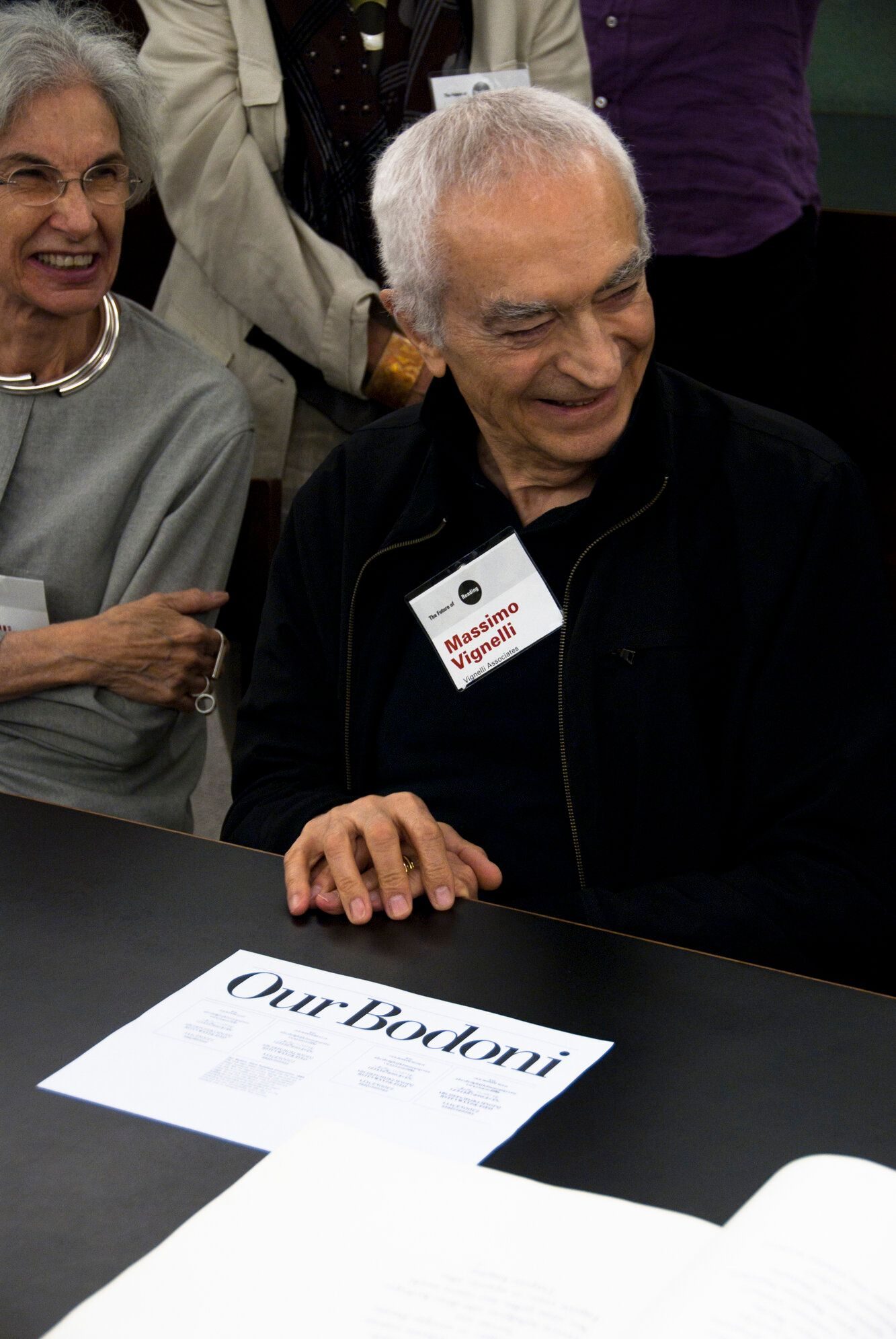
Massimo Vignelli (1931–2014) is the Italian-American graphic designer who carried European modernism — Helvetica, the grid, Bodoni, no more than six typefaces — into every corner of American corporate and public life. From the 1972 New York Subway map to American Airlines and Knoll, his work defined the language of serious design for half a century.

Key facts

Born
10 January 1931, Milan, Italy
Died
27 May 2014, New York City, United States
Nationality
Italian / American
Era
International Typographic Style — American postwar modernism
Studios
Unimark International (co-founder, 1965) · Vignelli Associates (1971)
Known for
1972 NYC Subway Map · American Airlines · Bloomingdale's · Knoll · United Colors of Benetton identities · The Vignelli Canon (2008)

Biography

Massimo Vignelli was born in Milan in 1931 into a middle-class Italian family. He studied architecture at the Politecnico di Milano and in Venice, and by his early twenties was already designing for Italian glassware and furniture manufacturers — the first signs of a career that would refuse to sit inside the discipline of graphics alone.

In 1957 he married Lella Valle, a fellow architect who would become his design partner for the next fifty-seven years. The Vignellis spent the late 1950s and early 1960s working between Italy and the United States, first on Fulbright fellowships, then on commercial commissions. In 1965 Massimo became a founding partner of Unimark International in Chicago — a modernist graphic-design practice that introduced Helvetica, grid systems and International Typographic Style to American corporate clients on an industrial scale.

From Unimark’s New York office, he led the redesign of the New York City Subway signage system (1966) and, with Joan Charysyn, the 1972 Subway Map — a purely diagrammatic rendering that divided critics and commuters for decades.

In 1971 the Vignellis left Unimark to found Vignelli Associates in New York. Over the next four decades they produced identity systems for American Airlines, Knoll, Bloomingdale’s, Lancia, Ford, IBM, Xerox and the US National Park Service. They worked across graphics, furniture, interiors, product design, silverware and stage sets, bringing the same reductionist logic to each.

Massimo died in New York in 2014. His archive — and the Vignelli Center for Design Studies at Rochester Institute of Technology — were established during his lifetime as a teaching resource for the discipline he spent his career refining.

Design philosophy

Vignelli’s position was unambiguous: design is a discipline of restraint. The working vocabulary of a designer should be small. Six typefaces are enough. A grid exists to be obeyed. Colour is a tool, not a decoration. Beauty is the result of precision.

“Styles come and go. Good design is a language, not a style.” — Massimo Vignelli, The Vignelli Canon (2008)

He wrote this not as an opinion but as an ethical position. He believed that much of what passed for graphic design in the late twentieth century was the visual equivalent of shouting, and that the job of the serious designer was to refuse. His typeface list ran to six: Garamond, Bodoni, Century, Futura, Helvetica, Times. Anything beyond that, he considered an admission of confusion.

“If you can design one thing, you can design everything.” — Massimo Vignelli

The corollary was a defence of what he called the semantic, syntactic, and pragmatic dimensions of design. A piece of work had to mean something (semantic), be internally consistent (syntactic) and actually perform in the world (pragmatic). The Vignelli Canon is structured around that triad.

He was dismissive of trend, decoration and novelty for its own sake. This made him polarising — the 1972 Subway Map is the canonical example — and made his work endure.

Key works

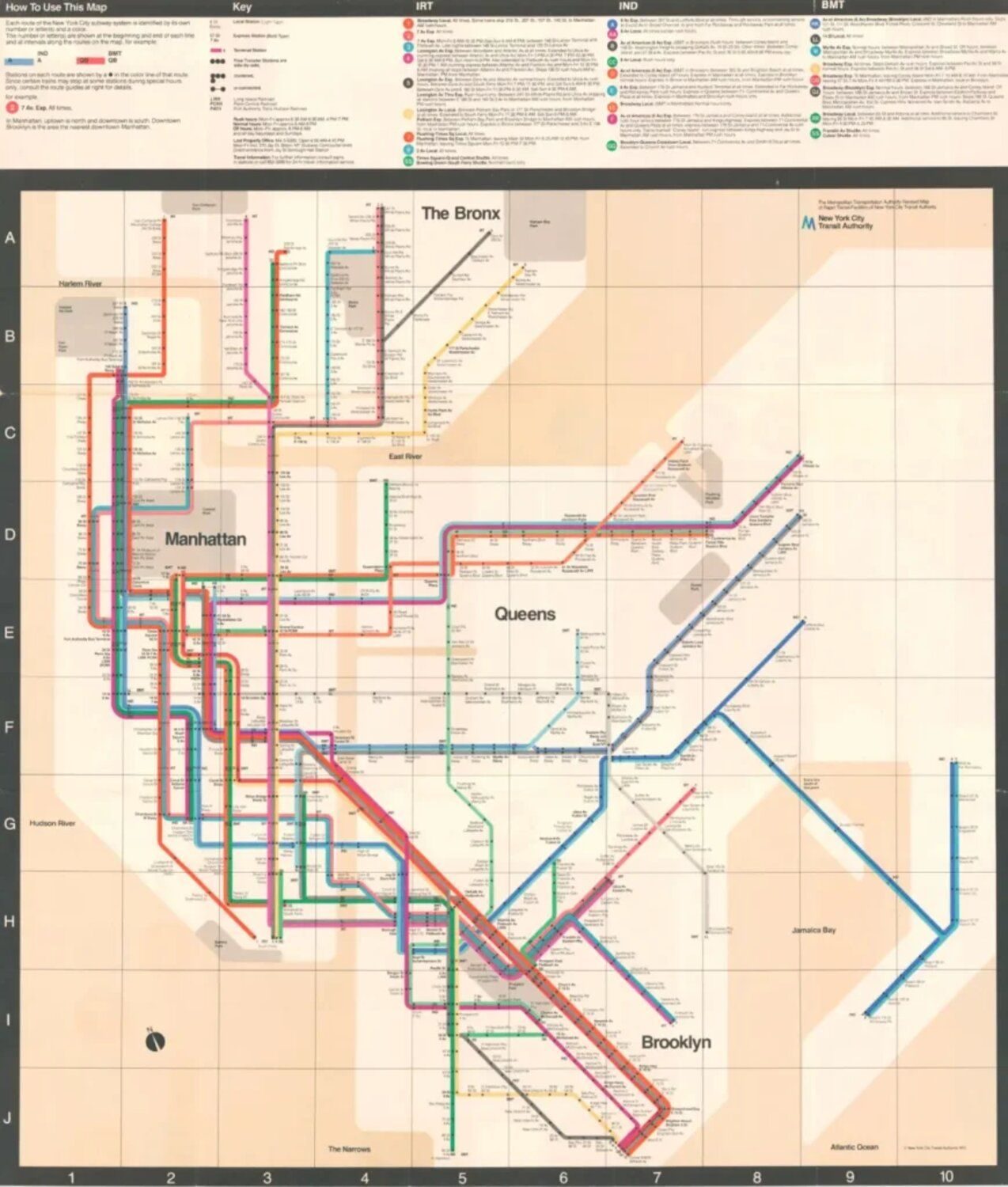
1972 New York City Subway Map — A diagrammatic map with 45° and 90° angles only, coloured lines for each route, and no geographic fidelity. Central Park is a square. It was replaced in 1979 after complaints about geographic inaccuracy. It returned in 2011 as the core of the MTA Weekender app, and again as the permanent “Second Avenue Subway” map. The first version was collected by the Museum of Modern Art in 2004.

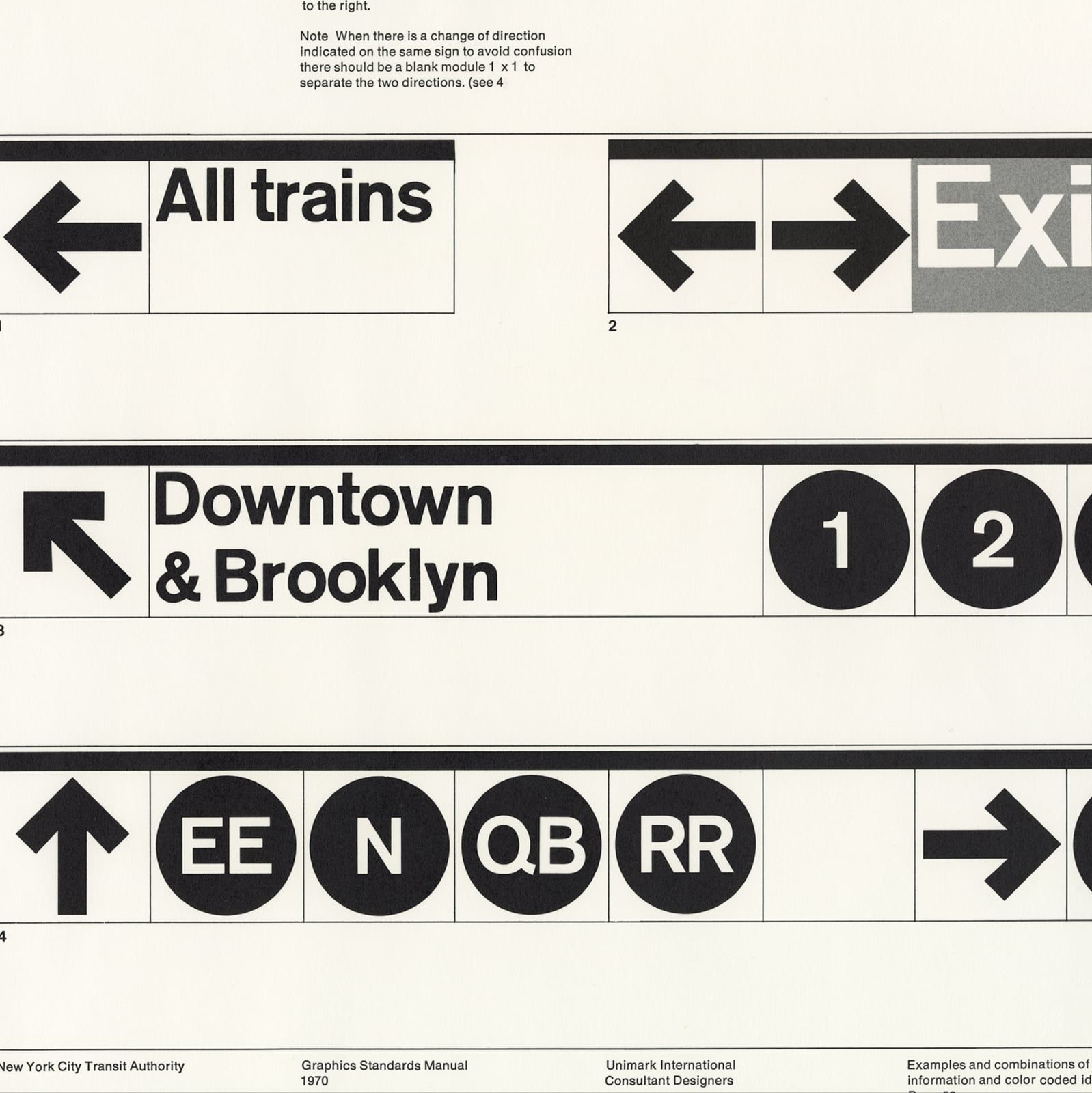
NYC Subway signage (1966) — With Bob Noorda at Unimark, a Helvetica-based station and wayfinding system that has defined the New York transit graphic language for half a century.

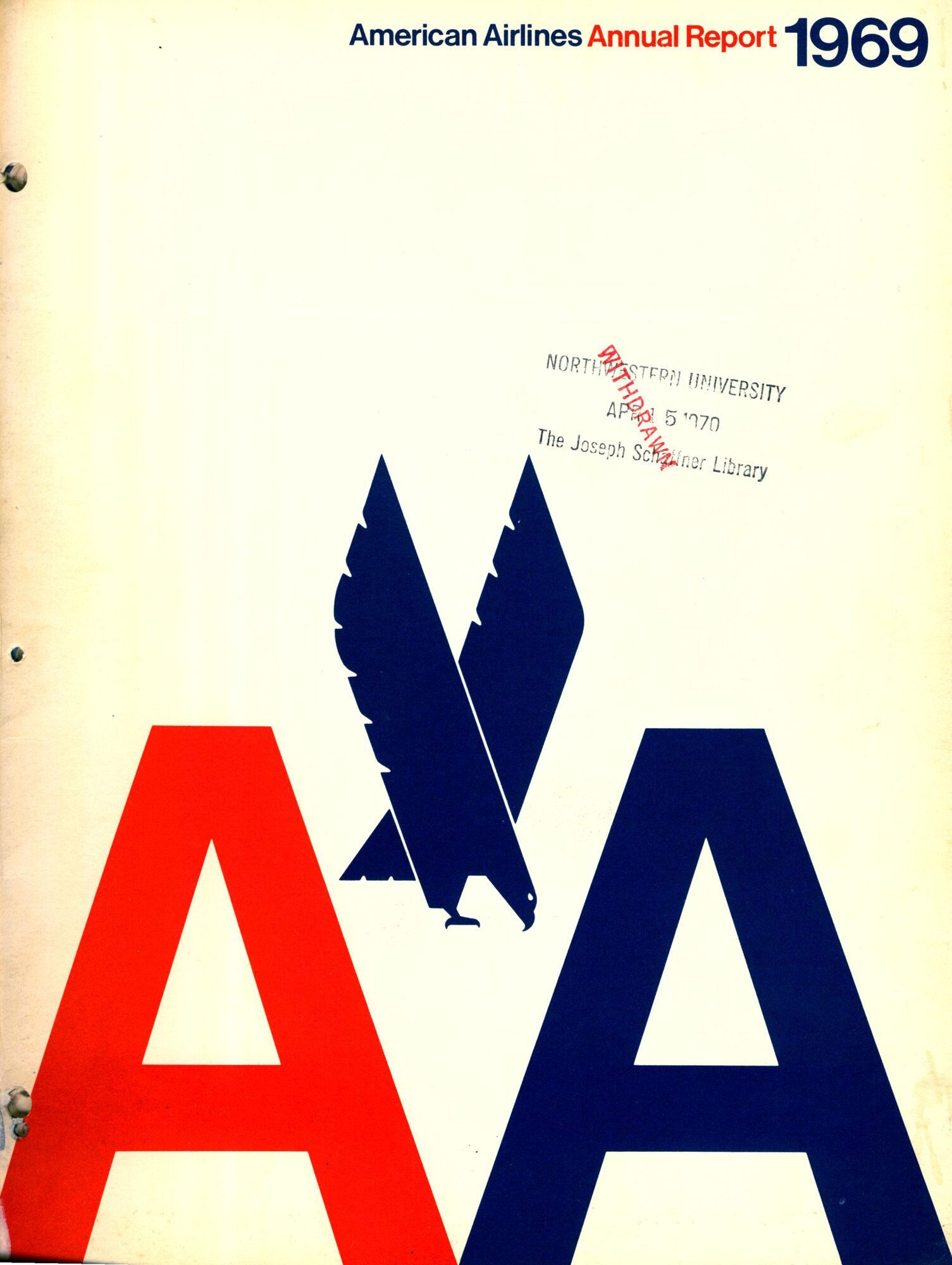
American Airlines identity (1967) — Stacked AA monogram, Helvetica wordmark, eagle detail. Unchanged for forty-six years.

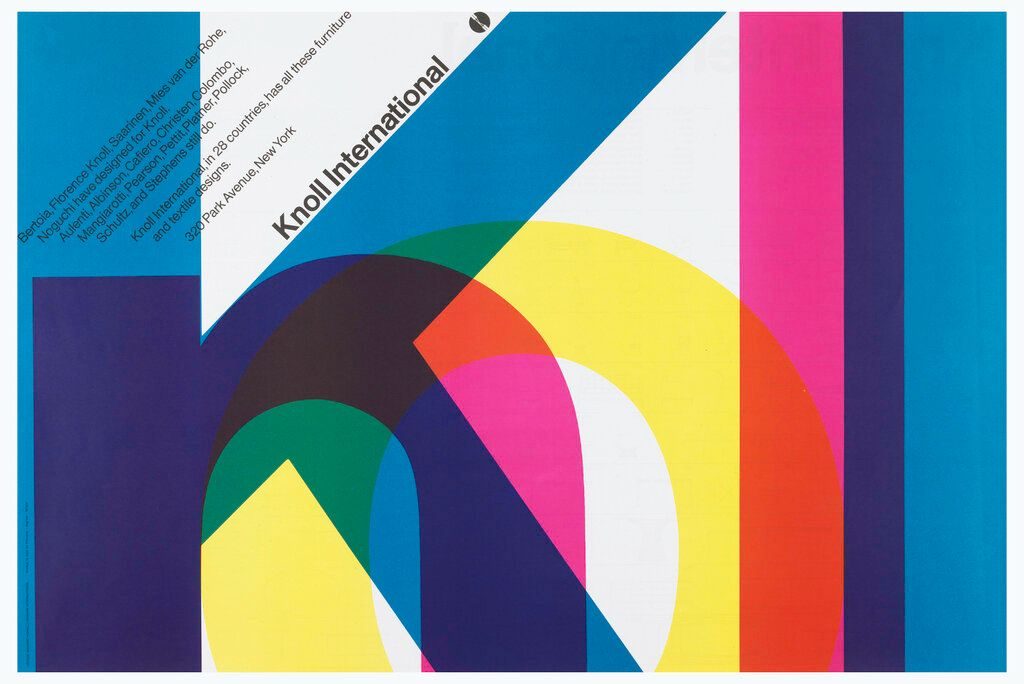
Knoll (1966 onward) — A modernist identity system and a decades-long advertising programme that became the template for how a furniture company presents itself.

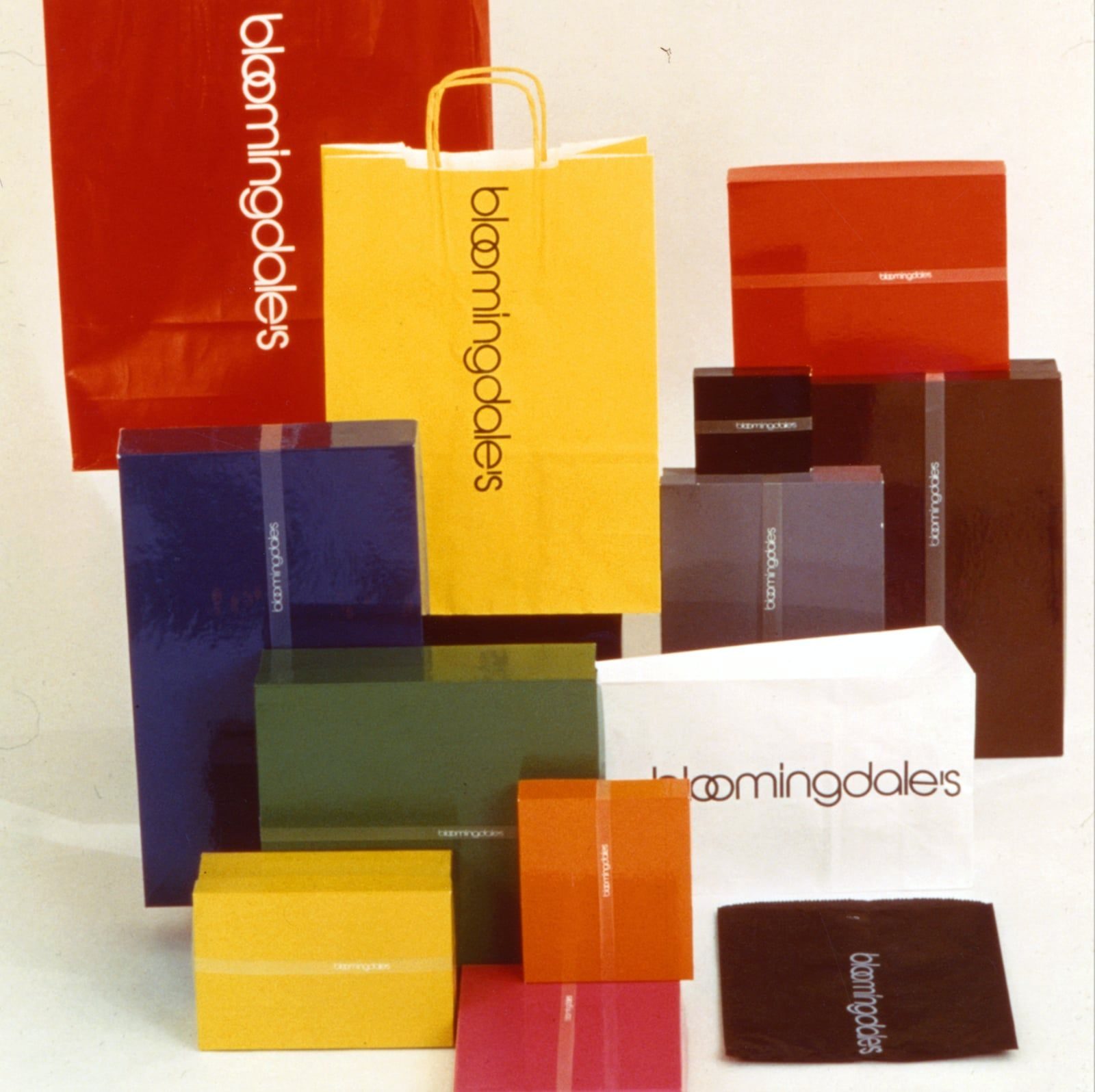
Bloomingdale’s (1972) — The “Big Brown Bag” shopping-bag family, extending the identity into physical merchandising.

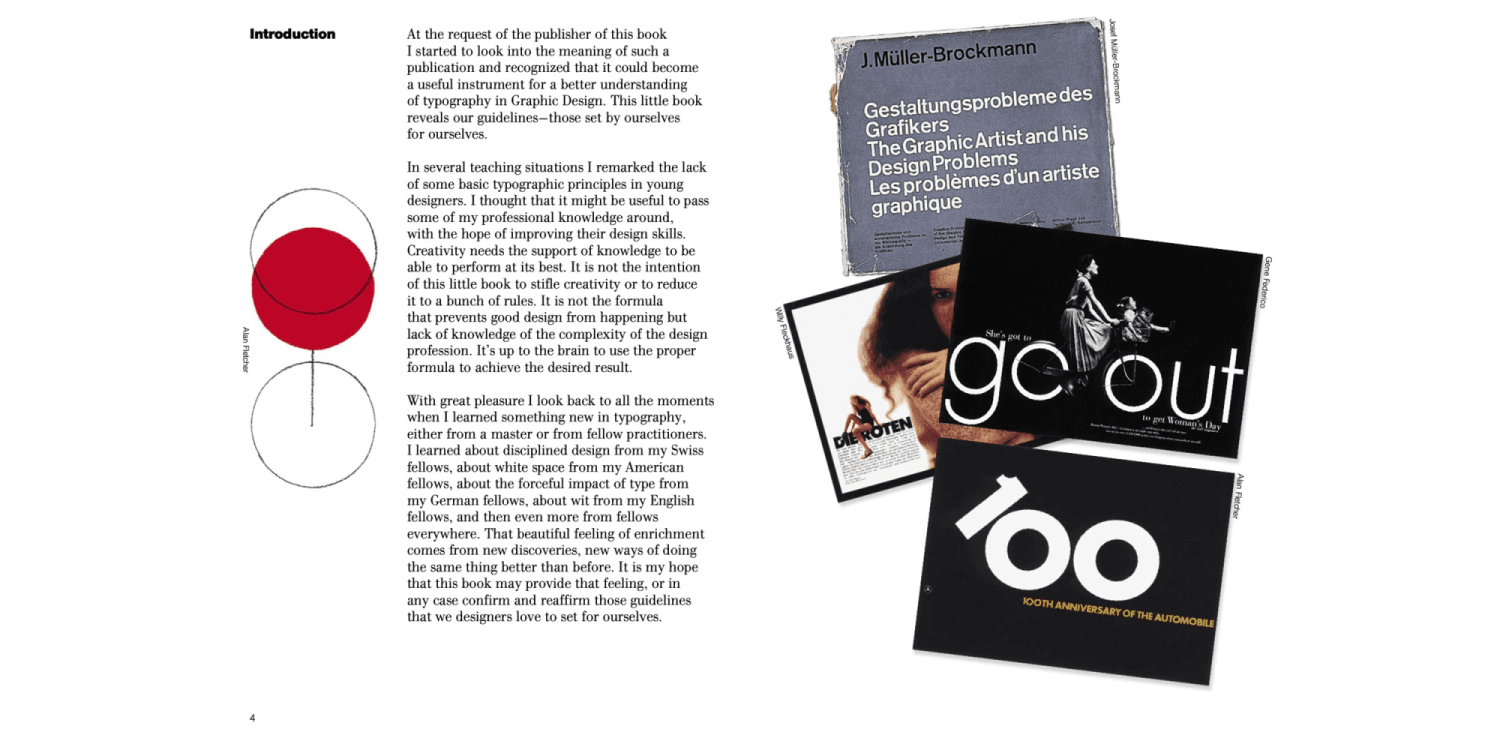
The Vignelli Canon (2008) — A 96-page handbook on the Vignelli approach to typography, grids and semantics. Published free online; later reissued by Lars Müller.

Iconic works

1972 New York City Subway Map, 1972

1972 New York City Subway Map

1972

Diagrammatic map of the New York City subway system, designed at Unimark International and commissioned by the New York City Transit Authority. The design used 45-degree and 90-degree angles throughout, with colour-coded route lines and uniform station labelling in Helvetica. Geographic fidelity was set aside in favour of legibility: Central Park appears as a square. The Transit Authority withdrew the map in 1979 following commuter complaints about navigational accuracy. MoMA acquired a copy for its permanent collection in 2004, and a digital adaptation became the basis of the MTA Weekender service alerts from 2011.
1972 New York City Subway Map (1972). · Embedded in Open Culture's design-history article with contextual commentary; readable editorial presentation of the map · Museum editorial
NYC Subway signage system, 1966

NYC Subway signage system

1966

Wayfinding and station signage system for the New York City Transit Authority, designed at Unimark International with Bob Noorda. The system standardised signage across the entire subway network using Helvetica Medium, a fixed grid of tile-mounted panels, and a colour-band structure for line identification. The design principles were codified in the NYCTA Graphics Standards Manual (1970), co-authored with Noorda. Much of the original Unimark signage remains in place across the network today.
NYC Subway signage system (1966). · Original Vignelli 1968 porcelain-enamel-on-steel station sign (actual artifact from the 1966–70 design period). For master-resolution versions, replace 'sized' with 'master' in URL path. · AU statutory
American Airlines identity, 1967

American Airlines identity

1967

Corporate identity for American Airlines, designed at Unimark International. The system comprised a Helvetica wordmark, a stacked AA monogram, and an eagle device rendered in red, white, and blue. It was applied across aircraft livery, airport signage, ticketing, and printed communications. The identity remained in use without substantive modification for forty-six years before being replaced by a FutureBrand rebrand in 2013.
American Airlines identity (1967). · American Airlines timetable (June 1968) showing the identity system in published communications; part of Northwestern's transportation design archive. · AU statutory
Knoll identity + advertising, 1966

Knoll identity + advertising

1966

Identity and advertising programme for Knoll International, the American furniture manufacturer founded by Hans and Florence Knoll. Vignelli took over as primary graphic designer from Herbert Matter, developing a modernist system covering catalogues, trade advertising, showroom graphics, and price lists. The programme continued for several decades and is widely studied as a case of graphic language matched to its subject: rigorous modernist furniture presented through rigorous modernist typography.
Knoll identity + advertising (1966). · Official Cooper Hewitt Smithsonian museum image of the 1967 offset lithograph poster (81.3 × 120.7 cm). Primary authoritative source with museum documentation. · Museum editorial
Bloomingdale's identity, 1972

Bloomingdale's identity

1972

Retail identity for Bloomingdale's department store in New York, commissioned by chairman Marvin Traub. The scheme centred on the "Big Brown Bag", a shopping bag in dark brown kraft paper with a condensed Helvetica logotype. The bag became one of the most recognised retail packaging objects in the United States through the 1970s and 1980s. The identity extended across carrier bags, gift boxes, and in-store print communications.
Bloomingdale's identity (1972). · PRINT Magazine's 50-year anniversary article header graphic showing the iconic Big Brown Bag design; editorial republication with sourcing to Bloomingdale's official. · Museum editorial
United Colors of Benetton (early identity), 1965

United Colors of Benetton (early identity)

1965

Early wordmark treatment for Benetton, the Italian knitwear manufacturer then trading as Fratelli Benetton. The commission applied International Typographic Style principles to Italian fashion retail at the moment the company was expanding from the Veneto into European markets. The wordmark brought disciplined, reductive lettering to a sector then dominated by decorative type. Benetton later adopted the "United Colors of Benetton" name and commissioned further graphic development through the 1980s.
United Colors of Benetton (early identity) (1965).
The Vignelli Canon, 2008

The Vignelli Canon

2008

A 96-page design handbook setting out Vignelli's working methodology across typography, grid systems, paper formats, and the semantic, syntactic, and pragmatic dimensions of design. Originally released as a free PDF by Vignelli Associates in 2008, it was issued in print by Lars Müller Publishers in 2010. The book specifies typefaces, point sizes, grid proportions, and colour relationships as a working vocabulary rather than a set of prescriptions. It is used as a reference text on typographic and identity-design courses internationally, and remains freely available as a PDF from the Vignelli Center at RIT.
The Vignelli Canon (2008). · Official publisher (Lars Müller) — 150 DPI high-quality product image; original edition cover · Museum editorial

Influence & legacy

Vignelli’s influence runs along two tracks. The first is his direct studio lineage: Michael Bierut, who joined Vignelli Associates in 1980 and spent a decade there before joining Pentagram, is the most prominent. Through Bierut, the Vignelli approach to grids, typography and institutional identity now circulates throughout the Pentagram New York office and its clients.

The second is the Vignelli Canon itself. Published free online in 2008, it has become a standard reference text for modernist graphic design. Designers who never met Vignelli quote the semantic / syntactic / pragmatic framework and the six-typeface list. It is one of the most successful acts of design pedagogy of the last fifty years.

The 1972 Subway Map is the case study through which American graphic design students learn the argument between modernist abstraction and user-centred pragmatism. It has been reversed, revived, debated and collected. Its presence at MoMA is a statement about the place of graphic design in the visual culture of the twentieth century.

Vignelli’s last public act was to co-design, with his son Luca and RIT students, the Vignelli Center for Design Studies at Rochester Institute of Technology — a building and a teaching programme intended to keep the discipline alive.

Learn at TGDS

Massimo Vignelli sits at the centre of our typography + grid teaching. If his work interests you, the most direct next steps are:

Courses

Further reading

Books

  • Massimo Vignelli, The Vignelli Canon (Lars Müller, 2010; free PDF via Vignelli Associates, 2008).
  • Massimo Vignelli + Lella Vignelli, Design: Vignelli (Rizzoli, 1990).
  • Peter Lloyd Wilson (ed.), Vignelli: From A to Z (Images Publishing, 2007).
  • Helvetica (dir. Gary Hustwit, 2007) — Vignelli interview is one of the film’s most-quoted segments.

Get Started.

You can enrol any day of the year. We are online and study is self-paced, there is no pressure. Enrol when you are ready to start, from anywhere in the world. If you would like to chat or email, feel free to get in touch.

Brochures, Phone Calls & Questions

You can download a free brochure, book a phone call with one of our course advisors, or simply ask a question.

Other ways to get in touch

Australia 1300 655 485

International +61 1300 655 485

Ask Anything info@thegraphicdesignschool.com

Get a quote accounts@thegraphicdesignschool.com

Acknowledgement of Country
The Graphic Design School acknowledges the Traditional Custodians of Country throughout Australia and their continued spiritual connection to land.
We pay respect to Elders past, present and emerging.
Always was, always will be.
RTO Provider № 91706